
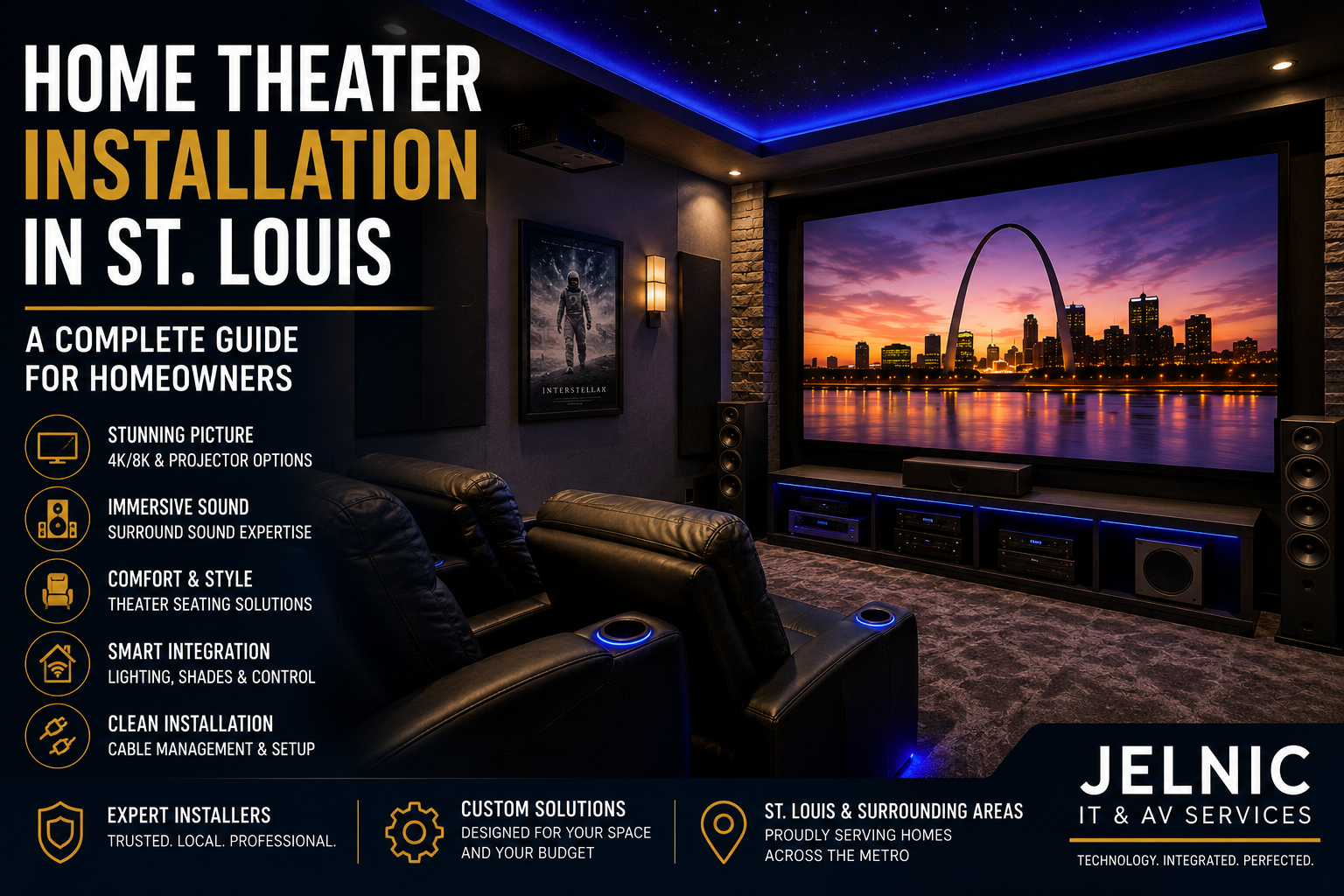
Imagine having a dedicated entertainment space where you can watch movies with theater-quality sound, enjoy your favorite sports with an immersive picture, or play video games on a large screen without leaving your home. For many homeowners, a professionally designed home theater installation in St. Louis can turn that idea into reality.
A home theater is more than simply putting a large television on a wall and connecting a few speakers. A properly designed system considers the room, screen size, viewing distance, sound distribution, lighting, seating, network connectivity, cable management, and the equipment needed to create a comfortable entertainment experience.
Whether you are converting an unused basement, upgrading a family room, or building a dedicated theater room, professional planning can help you get more from your investment.
This complete guide explains what St. Louis homeowners should know before starting a home theater project.
What Is a Home Theater Installation?
A home theater installation involves designing and configuring an entertainment system specifically for the room where it will be used.
Depending on the homeowner’s goals and budget, a home theater can include:
- Large-screen television
- 4K or high-resolution display
- Projector and projection screen
- Surround sound speakers
- Soundbar
- AV receiver
- Subwoofer
- Streaming devices
- Gaming consoles
- Blu-ray or media players
- Smart home controls
- Automated lighting
- Motorized shades
- Dedicated theater seating
- Network and WiFi connectivity
- Professional cable management
Not every home theater needs all of these components.
The right system depends on the size of the room, how you plan to use it, your existing equipment, and the type of entertainment experience you want.
1. Start With the Room
The room is one of the most important parts of a successful home theater.
Before purchasing equipment, consider the room’s dimensions, ceiling height, windows, doors, flooring, wall surfaces, and available seating area.
A large basement may provide enough space for a dedicated theater, while a smaller family room may be better suited to a high-quality TV and soundbar or compact surround sound system.
The location of windows is also important because natural light can affect the picture.
A room with significant sunlight may require blackout curtains, shades, or another lighting solution if you plan to use a projector.
The shape of the room can also influence speaker placement.
Professional AV installation begins with understanding the environment before recommending equipment.
2. Choose Between a TV and Projector
One of the biggest decisions in a home theater project is whether to use a large-screen television or projector.
Large-Screen TV
A modern large-screen TV can provide excellent picture quality, strong brightness, and convenient access to streaming services.
Televisions are often a good choice for family rooms and multipurpose spaces because they can be used during the day without requiring the room to be completely dark.
Projector and Screen
A projector can create a more traditional theater experience with a very large image.
Projectors can be particularly attractive for dedicated theater rooms where the lighting can be controlled.
However, a projector system requires more planning. You need to consider the projector location, screen size, throw distance, ceiling mounting, available power, cable routing, and room lighting.
A professional home theater installer in St. Louis can help you determine which option makes sense for your space.
3. Select the Right Screen Size
Bigger is not always better.
The appropriate screen size depends on the viewing distance and the room layout.
A screen that is too small may not provide the immersive experience you want, while a screen that is too large can make viewing uncomfortable if you are sitting too close.
Your seating arrangement should therefore be considered before deciding on the screen or television size.
The goal is to create a balanced viewing experience where the picture fills an appropriate portion of your field of vision without becoming overwhelming.
Professional planning can help you determine the right screen position and size before installation begins.
4. Plan Your Surround Sound System
Picture quality is only half of the home theater experience.
Audio plays a major role in making movies, sports, games, and television more immersive.
A surround sound system can distribute audio throughout the room so that dialogue, music, sound effects, and other audio elements feel more natural and engaging.
Depending on the room and system, you might use:
- Front speakers
- Center channel speaker
- Surround speakers
- Rear speakers
- Height speakers
- Subwoofer
- Soundbar
- AV receiver
The correct speaker arrangement depends on the room and the equipment.
A professional surround sound installation can help ensure that speakers are positioned appropriately and connected correctly.
5. Don’t Forget the Subwoofer
Bass can make a major difference in a home theater.
A subwoofer reproduces low-frequency sounds such as explosions, music, special effects, and other deep audio.
However, simply placing a subwoofer in the corner of the room does not always produce the best results.
Room acoustics can cause bass to sound stronger in some areas and weaker in others.
A professional AV installer can help determine an appropriate location for the subwoofer and configure the system for the room.
6. Consider Room Acoustics
The sound in your home theater is affected by the room itself.
Hard surfaces such as bare floors, glass, and large empty walls can reflect sound. Furniture, carpets, curtains, and other materials can absorb or diffuse sound.
You do not necessarily need a professionally treated recording studio to have a good home theater.
However, thoughtful placement of furniture, curtains, rugs, acoustic panels, and speakers can improve the overall experience.
If you are building a dedicated theater, acoustic treatment may be worth considering during the design stage rather than after everything has been installed.
7. Plan Your TV or Projector Mounting
Proper mounting is an important part of a professional home theater.
If you are using a television, the display should be securely mounted at an appropriate height.
A professional TV installer can help determine the mounting position and manage cables for a clean appearance.
If the TV is being installed above a fireplace, additional considerations may be required.
For projector-based systems, ceiling mounting may be necessary.
The projector must be positioned correctly relative to the screen, and the mounting system must support the equipment securely.
Cable routing should also be planned before the walls or ceiling are finished.
8. Cable Management Matters
One of the easiest ways to make a high-end entertainment system look unfinished is to leave cables hanging everywhere.
A professional AV installation should include cable management planning.
Depending on your setup, you may need connections for:
- HDMI
- Ethernet
- Speaker cables
- Power
- Streaming devices
- Gaming consoles
- AV receivers
- Projectors
- Subwoofers
- Smart home equipment
Some cables may be concealed within walls or ceilings when appropriate, while others may be organized using suitable raceways or other cable-management solutions.
Planning cable routes before installation can make future upgrades much easier.
9. Make Sure Your WiFi and Network Can Handle Your Theater
Modern home theaters rely heavily on network connectivity.
Streaming movies and shows, downloading games, using smart TVs, connecting gaming consoles, and accessing online content all require a reliable network.
If your theater is located in a basement, far from the router, or behind several walls, WiFi performance may not be ideal.
A professional WiFi installation or network upgrade may be worth considering.
Depending on the home, options may include:
- Additional wireless access points
- Wired Ethernet connections
- Mesh networking
- Network equipment upgrades
- Better router placement
- Dedicated connections for entertainment devices
A company that handles both home theater installation and network installation can address these requirements as part of one project.
10. Consider Smart Home Integration
A home theater can become even more convenient when it is connected to your smart home system.
For example, you may want one control system to operate:
- Television or projector
- Audio equipment
- Lighting
- Motorized shades
- Streaming devices
- Smart home equipment
Smart home integration can reduce the number of remotes and simplify everyday use.
If your home already uses platforms such as Google Home or other smart home devices, discuss compatibility before purchasing new theater equipment.
11. Lighting Can Transform the Experience
Lighting is often overlooked during home theater design.
Bright overhead lights can create glare on a television or wash out a projector image.
At the same time, you do not want the room to be completely dark when people are walking around or getting snacks.
Consider using layered lighting.
Options may include:
- Dimmable ceiling lights
- Wall sconces
- Accent lighting
- LED lighting
- Step lighting
- Smart lighting controls
- Automated scenes
For example, a “movie” setting could dim the main lights while leaving low-level lighting around the seating area.
12. Choose Comfortable Seating
Your home theater should be comfortable enough for the length of the movies, games, or events you plan to watch.
Seating options can include traditional sofas, reclining theater seats, sectional furniture, or dedicated home theater chairs.
The number of seats should be considered before finalizing the screen and speaker positions.
You should also leave enough space for people to move comfortably around the room.
13. Think About Gaming
If your household enjoys gaming, tell your installer before the system is designed.
Gaming can have different requirements from movie watching.
You may need additional HDMI connections, gaming consoles, Ethernet connections, low-latency networking, extra seating, or a display capable of supporting the features you want.
A well-designed theater can accommodate movies, sports, streaming, and gaming without requiring you to constantly reconnect equipment.
14. Don’t Overlook Universal Control
Multiple remotes can quickly become frustrating.
A professionally configured system can simplify control of the theater.
Depending on the equipment, a universal remote, smart home platform, or other control solution can allow users to manage several components from one interface.
For example, you could have a simple “Watch Movie” setup that turns on the display, selects the appropriate input, starts the audio system, and adjusts compatible lighting.
The exact capabilities depend on the equipment and control platform.
15. Consider Future Upgrades
Technology changes quickly.
When designing your home theater, think beyond what you need today.
Planning extra cable capacity, network connections, power access, and equipment space can make future upgrades easier.
For example, you may eventually want to add:
- Additional speakers
- New gaming consoles
- Streaming equipment
- A larger TV
- A newer projector
- Smart lighting
- Security integration
- Improved WiFi
- Additional network devices
Professional installation can help you build flexibility into the system from the beginning.
How Much Does Home Theater Installation Cost in St. Louis?
The cost of home theater installation in St. Louis can vary significantly.
A simple entertainment setup may involve installing a TV, soundbar, and a few connected devices.
A dedicated theater may involve a large display or projector, multiple speakers, AV equipment, specialized wiring, lighting, networking, smart home integration, and custom installation.
The biggest factors affecting cost include:
- Room size
- Television or projector choice
- Screen size
- Number of speakers
- AV receiver
- Mounting requirements
- Cable concealment
- Network installation
- Lighting
- Smart home integration
- Acoustic treatment
- Custom construction
- Labor and installation complexity
Rather than choosing equipment based solely on price, it is better to determine your priorities first.
A professional installer can then help create a system that fits your room and budget.
DIY vs. Professional Home Theater Installation
Some homeowners are comfortable installing individual pieces of entertainment equipment themselves.
However, a complete home theater can become complicated quickly.
Installing a TV is one task. Coordinating the TV, projector, speakers, AV receiver, network, streaming devices, lighting, cable management, and smart home controls is another.
Professional installation can save time and reduce the risk of incorrect connections or poorly positioned equipment.
It can also provide a cleaner finished appearance.
If you have invested significantly in your equipment, professional installation can help ensure that the system is configured properly.
Why Choose a Local Home Theater Installer in St. Louis?
Working with a local technology provider can make the process easier from design through installation.
A local St. Louis home theater installer can assess your space, discuss your goals, recommend an appropriate setup, install the equipment, and provide support if you later want to expand the system.
This can be particularly useful when your theater is part of a larger smart home or technology project.
Your future needs may include WiFi upgrades, security cameras, smart home automation, additional TVs, or other AV equipment.
Working with one technology provider can help keep your systems organized.
JELNIC IT & AV Services
JELNIC IT & AV Services provides technology solutions for homeowners and businesses, including home theater installation, TV installation, TV mounting, AV services, WiFi installation, network installation, smart home services, security camera installation, and IT support.
Whether you are creating a dedicated home cinema, upgrading a family room, installing surround sound, or integrating your entertainment system with smart home technology, professional planning can help you get the best experience from your equipment.
JELNIC also supports popular smart home technologies and connected devices, helping homeowners build convenient and integrated technology environments.
From the display and speakers to the network and cable management, the goal is to create a system that is easy to use and designed around the way your household enjoys entertainment.
Final Thoughts
A successful home theater is about more than buying the biggest television or most powerful speakers.
The room, viewing distance, screen size, speaker placement, acoustics, lighting, networking, cable management, and control system all contribute to the final experience.
If you are considering home theater installation in St. Louis, start by defining how you want to use the room. Do you primarily watch movies? Are you a sports fan? Do you play video games? Do you want a dedicated theater or a multipurpose family entertainment room?
Once you understand your goals, a professional installer can help turn those requirements into a practical system.
With the right planning and professional AV installation, your home theater can become one of the most enjoyable spaces in your home.
Whether you need St. Louis home theater installation, surround sound installation, TV mounting, AV services, WiFi installation, or smart home integration, JELNIC IT & AV Services can help you design and install a technology solution tailored to your home.
JELNIC Does It — professional technology solutions for your home and business.
Home Theater Installation in St. Louis: A Complete Guide for Homeowners
Imagine having a dedicated entertainment space where you can watch movies with theater-quality sound, enjoy your favorite sports with an immersive picture, or play video games on a large screen without leaving your home. For many homeowners, a professionally designed home theater installation in St. Louis can turn that idea into reality.
A home theater is more than simply putting a large television on a wall and connecting a few speakers. A properly designed system considers the room, screen size, viewing distance, sound distribution, lighting, seating, network connectivity, cable management, and the equipment needed to create a comfortable entertainment experience.
Whether you are converting an unused basement, upgrading a family room, or building a dedicated theater room, professional planning can help you get more from your investment.
This complete guide explains what St. Louis homeowners should know before starting a home theater project.
What Is a Home Theater Installation?
A home theater installation involves designing and configuring an entertainment system specifically for the room where it will be used.
Depending on the homeowner’s goals and budget, a home theater can include:
- Large-screen television
- 4K or high-resolution display
- Projector and projection screen
- Surround sound speakers
- Soundbar
- AV receiver
- Subwoofer
- Streaming devices
- Gaming consoles
- Blu-ray or media players
- Smart home controls
- Automated lighting
- Motorized shades
- Dedicated theater seating
- Network and WiFi connectivity
- Professional cable management
Not every home theater needs all of these components.
The right system depends on the size of the room, how you plan to use it, your existing equipment, and the type of entertainment experience you want.
1. Start With the Room
The room is one of the most important parts of a successful home theater.
Before purchasing equipment, consider the room’s dimensions, ceiling height, windows, doors, flooring, wall surfaces, and available seating area.
A large basement may provide enough space for a dedicated theater, while a smaller family room may be better suited to a high-quality TV and soundbar or compact surround sound system.
The location of windows is also important because natural light can affect the picture.
A room with significant sunlight may require blackout curtains, shades, or another lighting solution if you plan to use a projector.
The shape of the room can also influence speaker placement.
Professional AV installation begins with understanding the environment before recommending equipment.
2. Choose Between a TV and Projector
One of the biggest decisions in a home theater project is whether to use a large-screen television or projector.
Large-Screen TV
A modern large-screen TV can provide excellent picture quality, strong brightness, and convenient access to streaming services.
Televisions are often a good choice for family rooms and multipurpose spaces because they can be used during the day without requiring the room to be completely dark.
Projector and Screen
A projector can create a more traditional theater experience with a very large image.
Projectors can be particularly attractive for dedicated theater rooms where the lighting can be controlled.
However, a projector system requires more planning. You need to consider the projector location, screen size, throw distance, ceiling mounting, available power, cable routing, and room lighting.
A professional home theater installer in St. Louis can help you determine which option makes sense for your space.
3. Select the Right Screen Size
Bigger is not always better.
The appropriate screen size depends on the viewing distance and the room layout.
A screen that is too small may not provide the immersive experience you want, while a screen that is too large can make viewing uncomfortable if you are sitting too close.
Your seating arrangement should therefore be considered before deciding on the screen or television size.
The goal is to create a balanced viewing experience where the picture fills an appropriate portion of your field of vision without becoming overwhelming.
Professional planning can help you determine the right screen position and size before installation begins.
4. Plan Your Surround Sound System
Picture quality is only half of the home theater experience.
Audio plays a major role in making movies, sports, games, and television more immersive.
A surround sound system can distribute audio throughout the room so that dialogue, music, sound effects, and other audio elements feel more natural and engaging.
Depending on the room and system, you might use:
- Front speakers
- Center channel speaker
- Surround speakers
- Rear speakers
- Height speakers
- Subwoofer
- Soundbar
- AV receiver
The correct speaker arrangement depends on the room and the equipment.
A professional surround sound installation can help ensure that speakers are positioned appropriately and connected correctly.
5. Don’t Forget the Subwoofer
Bass can make a major difference in a home theater.
A subwoofer reproduces low-frequency sounds such as explosions, music, special effects, and other deep audio.
However, simply placing a subwoofer in the corner of the room does not always produce the best results.
Room acoustics can cause bass to sound stronger in some areas and weaker in others.
A professional AV installer can help determine an appropriate location for the subwoofer and configure the system for the room.
6. Consider Room Acoustics
The sound in your home theater is affected by the room itself.
Hard surfaces such as bare floors, glass, and large empty walls can reflect sound. Furniture, carpets, curtains, and other materials can absorb or diffuse sound.
You do not necessarily need a professionally treated recording studio to have a good home theater.
However, thoughtful placement of furniture, curtains, rugs, acoustic panels, and speakers can improve the overall experience.
If you are building a dedicated theater, acoustic treatment may be worth considering during the design stage rather than after everything has been installed.
7. Plan Your TV or Projector Mounting
Proper mounting is an important part of a professional home theater.
If you are using a television, the display should be securely mounted at an appropriate height.
A professional TV installer can help determine the mounting position and manage cables for a clean appearance.
If the TV is being installed above a fireplace, additional considerations may be required.
For projector-based systems, ceiling mounting may be necessary.
The projector must be positioned correctly relative to the screen, and the mounting system must support the equipment securely.
Cable routing should also be planned before the walls or ceiling are finished.
8. Cable Management Matters
One of the easiest ways to make a high-end entertainment system look unfinished is to leave cables hanging everywhere.
A professional AV installation should include cable management planning.
Depending on your setup, you may need connections for:
- HDMI
- Ethernet
- Speaker cables
- Power
- Streaming devices
- Gaming consoles
- AV receivers
- Projectors
- Subwoofers
- Smart home equipment
Some cables may be concealed within walls or ceilings when appropriate, while others may be organized using suitable raceways or other cable-management solutions.
Planning cable routes before installation can make future upgrades much easier.
9. Make Sure Your WiFi and Network Can Handle Your Theater
Modern home theaters rely heavily on network connectivity.
Streaming movies and shows, downloading games, using smart TVs, connecting gaming consoles, and accessing online content all require a reliable network.
If your theater is located in a basement, far from the router, or behind several walls, WiFi performance may not be ideal.
A professional WiFi installation or network upgrade may be worth considering.
Depending on the home, options may include:
- Additional wireless access points
- Wired Ethernet connections
- Mesh networking
- Network equipment upgrades
- Better router placement
- Dedicated connections for entertainment devices
A company that handles both home theater installation and network installation can address these requirements as part of one project.
10. Consider Smart Home Integration
A home theater can become even more convenient when it is connected to your smart home system.
For example, you may want one control system to operate:
- Television or projector
- Audio equipment
- Lighting
- Motorized shades
- Streaming devices
- Smart home equipment
Smart home integration can reduce the number of remotes and simplify everyday use.
If your home already uses platforms such as Google Home or other smart home devices, discuss compatibility before purchasing new theater equipment.
11. Lighting Can Transform the Experience
Lighting is often overlooked during home theater design.
Bright overhead lights can create glare on a television or wash out a projector image.
At the same time, you do not want the room to be completely dark when people are walking around or getting snacks.
Consider using layered lighting.
Options may include:
- Dimmable ceiling lights
- Wall sconces
- Accent lighting
- LED lighting
- Step lighting
- Smart lighting controls
- Automated scenes
For example, a “movie” setting could dim the main lights while leaving low-level lighting around the seating area.
12. Choose Comfortable Seating
Your home theater should be comfortable enough for the length of the movies, games, or events you plan to watch.
Seating options can include traditional sofas, reclining theater seats, sectional furniture, or dedicated home theater chairs.
The number of seats should be considered before finalizing the screen and speaker positions.
You should also leave enough space for people to move comfortably around the room.
13. Think About Gaming
If your household enjoys gaming, tell your installer before the system is designed.
Gaming can have different requirements from movie watching.
You may need additional HDMI connections, gaming consoles, Ethernet connections, low-latency networking, extra seating, or a display capable of supporting the features you want.
A well-designed theater can accommodate movies, sports, streaming, and gaming without requiring you to constantly reconnect equipment.
14. Don’t Overlook Universal Control
Multiple remotes can quickly become frustrating.
A professionally configured system can simplify control of the theater.
Depending on the equipment, a universal remote, smart home platform, or other control solution can allow users to manage several components from one interface.
For example, you could have a simple “Watch Movie” setup that turns on the display, selects the appropriate input, starts the audio system, and adjusts compatible lighting.
The exact capabilities depend on the equipment and control platform.
15. Consider Future Upgrades
Technology changes quickly.
When designing your home theater, think beyond what you need today.
Planning extra cable capacity, network connections, power access, and equipment space can make future upgrades easier.
For example, you may eventually want to add:
- Additional speakers
- New gaming consoles
- Streaming equipment
- A larger TV
- A newer projector
- Smart lighting
- Security integration
- Improved WiFi
- Additional network devices
Professional installation can help you build flexibility into the system from the beginning.
How Much Does Home Theater Installation Cost in St. Louis?
The cost of home theater installation in St. Louis can vary significantly.
A simple entertainment setup may involve installing a TV, soundbar, and a few connected devices.
A dedicated theater may involve a large display or projector, multiple speakers, AV equipment, specialized wiring, lighting, networking, smart home integration, and custom installation.
The biggest factors affecting cost include:
- Room size
- Television or projector choice
- Screen size
- Number of speakers
- AV receiver
- Mounting requirements
- Cable concealment
- Network installation
- Lighting
- Smart home integration
- Acoustic treatment
- Custom construction
- Labor and installation complexity
Rather than choosing equipment based solely on price, it is better to determine your priorities first.
A professional installer can then help create a system that fits your room and budget.
DIY vs. Professional Home Theater Installation
Some homeowners are comfortable installing individual pieces of entertainment equipment themselves.
However, a complete home theater can become complicated quickly.
Installing a TV is one task. Coordinating the TV, projector, speakers, AV receiver, network, streaming devices, lighting, cable management, and smart home controls is another.
Professional installation can save time and reduce the risk of incorrect connections or poorly positioned equipment.
It can also provide a cleaner finished appearance.
If you have invested significantly in your equipment, professional installation can help ensure that the system is configured properly.
Why Choose a Local Home Theater Installer in St. Louis?
Working with a local technology provider can make the process easier from design through installation.
A local St. Louis home theater installer can assess your space, discuss your goals, recommend an appropriate setup, install the equipment, and provide support if you later want to expand the system.
This can be particularly useful when your theater is part of a larger smart home or technology project.
Your future needs may include WiFi upgrades, security cameras, smart home automation, additional TVs, or other AV equipment.
Working with one technology provider can help keep your systems organized.
JELNIC IT & AV Services
JELNIC IT & AV Services provides technology solutions for homeowners and businesses, including home theater installation, TV installation, TV mounting, AV services, WiFi installation, network installation, smart home services, security camera installation, and IT support.
Whether you are creating a dedicated home cinema, upgrading a family room, installing surround sound, or integrating your entertainment system with smart home technology, professional planning can help you get the best experience from your equipment.
JELNIC also supports popular smart home technologies and connected devices, helping homeowners build convenient and integrated technology environments.
From the display and speakers to the network and cable management, the goal is to create a system that is easy to use and designed around the way your household enjoys entertainment.
Final Thoughts
A successful home theater is about more than buying the biggest television or most powerful speakers.
The room, viewing distance, screen size, speaker placement, acoustics, lighting, networking, cable management, and control system all contribute to the final experience.
If you are considering home theater installation in St. Louis, start by defining how you want to use the room. Do you primarily watch movies? Are you a sports fan? Do you play video games? Do you want a dedicated theater or a multipurpose family entertainment room?
Once you understand your goals, a professional installer can help turn those requirements into a practical system.
With the right planning and professional AV installation, your home theater can become one of the most enjoyable spaces in your home.
Whether you need St. Louis home theater installation, surround sound installation, TV mounting, AV services, WiFi installation, or smart home integration, JELNIC IT & AV Services can help you design and install a technology solution tailored to your home.
JELNIC Does It — professional technology solutions for your home and business.